Long-Term Retrieval (Glr)
For parents · Essentials: about 2 minutes · Full guide: about 10 minutes
First Clarity Guide? Read the Start Here guide first. It walks through the whole tool.
Your child’s filing cabinet and file clerk: learning new information, storing it through associations, and finding it later. Glr includes both learning efficiency and retrieval fluency. It is not a complete measure of memory, knowledge, attention, or motivation.
A blank answer does not tell you why retrieval failed. The information may not have been learned securely, or access may be slow or inconsistent. Attention, language, stress, sleep, cueing, and task demands can also affect performance.
Use retrieval practice with feedback. Close the book, try to recall a small amount, then check and correct the answer. Re-reading can help, but it should not be the only study method.
Use a cue while teaching. A first letter, category, picture, or sentence starter may help the child locate information. During testing, use cues only when the teacher or test directions allow them.
Space practice over time. Several short review sessions on different days usually support durable learning better than one long session.
Patterns you might notice at home ›
A child may answer correctly during practice but struggle to retrieve the same information later or in a different setting. One missed answer is not a pattern; notice whether the difficulty repeats across well-learned material.
- Frequent word-finding pauses for familiar words, followed by the word appearing later
- Stories may include pauses or restarts while the child searches for names, words, or details
- Names or facts may be difficult to produce on demand but easier with a cue or additional time
- Some highly connected or frequently practiced information may be easier to retrieve than isolated facts
- The child may describe the meaning or context without producing the exact word or name
- “I knew this last night, I swear!”
- “It’s on the tip of my tongue.”
- “Wait, don’t tell me… ugh, tell me.”
- “Why do I even study?” (Respond to the discouragement and review how the child is studying.)
Word finding and forgetting can also reflect attention, language, stress, sleep, limited practice, hearing, health, or normal variation. Look for repeated patterns and use evaluation data when a cognitive determination matters.
Patterns you might notice at school ›
- Math facts may remain effortful to retrieve even when the student understands the mathematical concept
- May perform better with recognition formats than with open recall, although the formats measure different demands
- May show stronger performance during guided review than during later independent recall
- Writing may include pauses for words, spelling patterns, or ideas; several other skills can also affect writing fluency
- May need additional response time before answering a question in class
- Isolated names, dates, vocabulary, or formulas may be harder to retrieve than information connected to a meaningful context
Retrieval difficulty at school may also reflect weak initial learning, reading or language demands, attention, anxiety, limited automaticity, unfamiliar content, or the assessment format. Recognition and recall tasks are not interchangeable.
Before calling it defiance ›
A student who cannot produce an answer may be called unprepared, careless, or accused of not studying. Those labels do not explain the breakdown.
Retrieval demand is one possibility. Initial learning, attention, language, anxiety, fatigue, task difficulty, study method, and motivation may also be involved. Better performance with a word bank is useful information, but it does not prove that retrieval is the only difficulty.
The behavior is the pressure gauge. When a child stops volunteering, avoids study, or says there is no point, pause before assigning intent. Review how the material was learned, add meaningful connections and spaced retrieval practice, and notice what changes. The response to support is not a diagnosis.
The emotional impact ›
Repeatedly knowing something during study and failing to retrieve it later can be discouraging and embarrassing.
Some children begin to think they are not smart, stop raising their hands, or avoid studying because the effort has not felt reliable. Those reactions are not proof of a Glr weakness, but they deserve support.
Avoid saying, “You would remember if it mattered.” Interest can support attention and learning, but forgetting is not a measure of love, effort, or character.
How strengths may support retrieval ›
Comprehension-Knowledge can provide meaningful connections that make new information easier to learn and locate. Fluid Reasoning may help organize facts into patterns. These strengths can support performance without changing the Glr vessel volume.
As material becomes less familiar or more dependent on isolated recall, earlier strategies may be less effective. Use stronger vessels to build more retrieval routes, and rely on a comprehensive evaluation when scores, disability, eligibility, or services matter.
When this bucket is full: the strength side ›
A Glr strength may help a child learn associations efficiently and retrieve familiar information fluently. It does not mean the child remembers everything, understands everything remembered, or has equally strong working memory and attention.
- May learn new associations with fewer repetitions and retrieve them later
- May retrieve well-learned facts, names, words, or details efficiently
- May remember past events and details that others have forgotten
- May tell a detailed story with efficient access to names and events
- May show fluent word finding in familiar topics and settings
Efficient retrieval does not guarantee deep understanding. Ask the child to explain why, compare ideas, and apply knowledge, not only state a remembered fact. Teach respect for people who need more practice or different retrieval cues.
- Feed the archive: these kids flourish on rich material worth remembering
- Push past recall: “you know the date; now tell me why it mattered”
- Invite them to help preserve family stories or organize information, without turning a strength into an obligation
- Teach respectful study-partner skills, including how to cue without giving the answer
The full home toolkit ›
- Space practice over time. Several short reviews on different days usually support more durable learning than one long session.
- Use retrieval practice with feedback. Recall a small amount without looking, check it, and correct errors. Re-reading may still be one part of study.
- Use cues during learning. Try a category, picture, first sound, or sentence starter. During a graded task, follow the teacher’s rules about assistance.
- Build meaningful connections. Link a new fact to a familiar idea, example, image, place, or interest.
- Try a mnemonic. A sentence, song, rhyme, gesture, or vivid image may create another retrieval route.
- Practice essential facts systematically. Continue brief, accurate practice after initial success and revisit the material later.
- Keep care separate from recall. Avoid “You would remember if you cared.” Ask what kind of cue or practice may help.
What might help at school ›
Possible supports to discuss with the student’s team include:
- Recognition formats when independent recall is not the skill or construct being measured
- Planned cues during instruction; during assessment, only cues permitted by the task and the student’s plan
- Spaced review and cumulative practice across the week and unit
- Fact charts or formula sheets when fact retrieval is not the skill being measured
- Additional response time or advance notice before calling on the student when appropriate
- Separate content knowledge from retrieval speed when retrieval fluency is not the instructional target
These are examples, not automatic IEP or Section 504 provisions. Changing from recall to recognition can change what an assessment measures. Supports must be individualized using evaluation results, classroom performance, instructional need, and progress data.
Advocacy language you can use ›
When talking to your child’s school team, you might say:
“My child often shows the information during guided review but has difficulty retrieving it later without a cue. Could we compare learning, delayed recall, recognition, and classroom performance?”
“When independent recall is not the learning goal, would a word bank or another response format let my child demonstrate the intended knowledge?”
“Evaluation and classroom data indicate difficulty retrieving previously learned information independently across relevant tasks. The team should consider spaced cumulative review, explicit retrieval practice, appropriate response time, and recognition supports only when independent recall is not the skill being measured. Effectiveness should be monitored.”
The student’s team must decide whether an accommodation is needed and how it should be written. A Glr score alone does not determine eligibility, services, or accommodations.
Technology that may help ›
- Spaced-practice flashcards: schedule brief review over several days and require the learner to retrieve before checking
- Voice memos: capture an idea or reminder before it is lost
- Photos when school rules permit: provide a visual cue for later review
- Recorded songs or rhymes: add a meaningful cue for selected information
- Searchable notes: store key information in an organized external reference
- Calendar reminders: prompt planned review days
Technology can support practice and access, but it does not diagnose or change Glr. Match the tool to the learner and the task.
You might have this too ›
If these struggles sound familiar, you may already pause before answering, use names in context, keep notes, or set reminders. Similar experiences can build empathy, but they do not establish your Glr level or your child’s.
A later answer suggests that access changed; it does not prove why the earlier blank occurred. Offer yourself and your child time, useful cues during learning, and study methods that create several retrieval routes.
You now have a plain-language way to talk about Glr. Finn Finding Bucket is the Bucket Hollow friend who uses a memory ladder, notebook, and memory rocks to build routes to important information. Finn gives children a character they can root for without turning the character, or this guide, into a diagnosis.
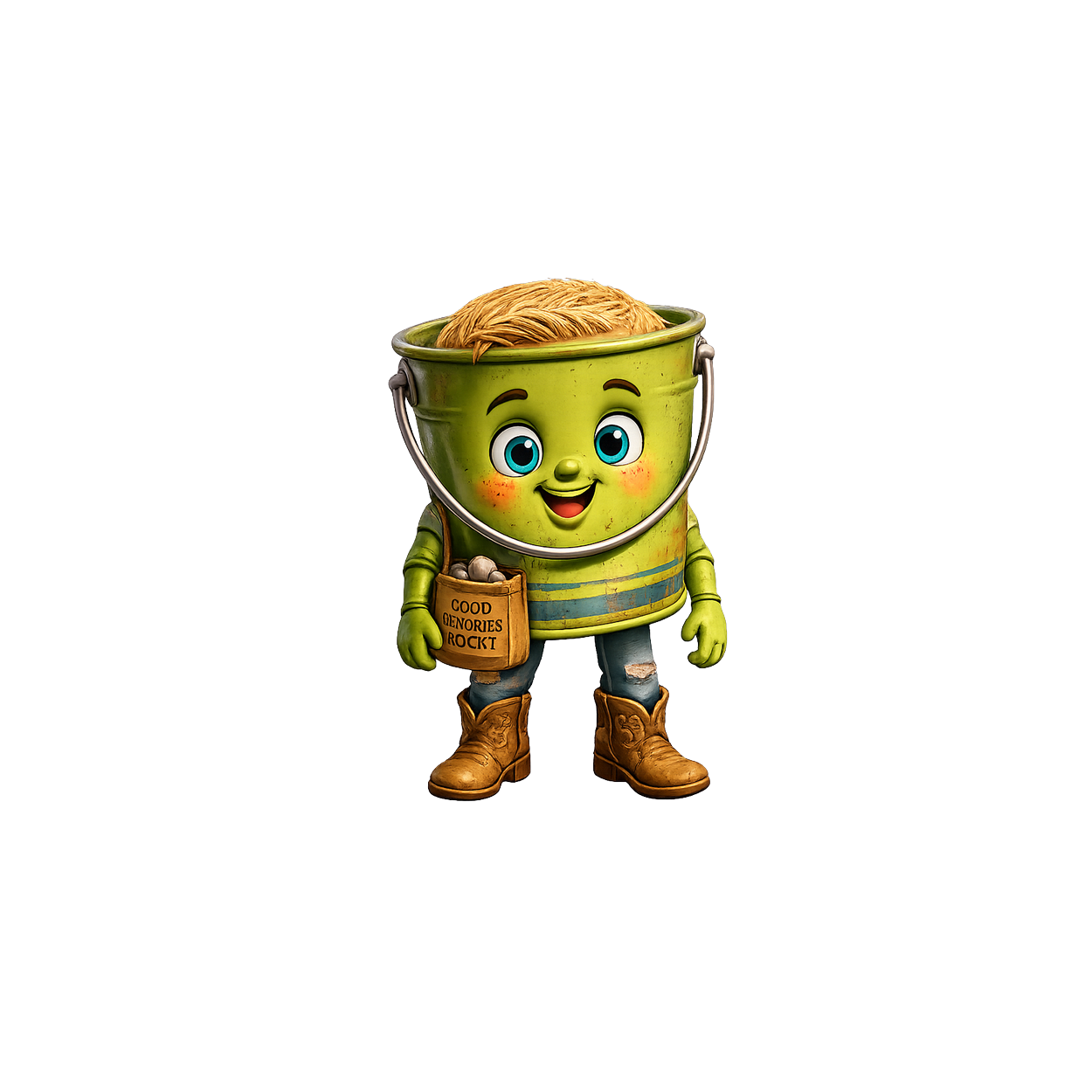
“I remember. Let me put that in my memory.”
Your child is not lazy. Not broken. They may need more routes to the information.
Learning and retrieval depend on the information, the task, and the conditions. Build meaningful connections, space practice, and seek a comprehensive evaluation when concerns persist. Ramps and ladders, not a label.
Take the Fill Finder Questionnaire to get your child’s Buckets and Barrels™ Individual Profile. Every bucket has its own Clarity Guide.
Start the Fill Finder →This guide is an educational tool. It does not diagnose a condition, estimate a cognitive-test score, replace a comprehensive evaluation, or determine IDEA or Section 504 eligibility, services, or accommodations. Supports must be individualized using evaluation results, classroom performance, instructional need, and progress data.
Still concerned? A parent may request a special-education evaluation from the local school district. In Texas, a written request sent to the director of special education or another district administrative employee generally requires a district response within 15 school days. If the parent gives written consent and the district evaluates, the evaluation report is generally due within 45 school days, subject to state rules and exceptions. Timelines vary by state.