Rhonda Brimmer Austin, M.Ed.Educational Diagnostician · 30 years in special education
"When we understand how a child's mind works, we can stop punishing what is hard and start celebrating what is strong."
🏠Before We Start
Before We Start
If you're reading this, there's a good chance you're tired. Maybe you left a school meeting where unfamiliar words were used to describe a child you know better than anyone. Maybe you've heard lazy, defiant, or unmotivated one too many times.
Maybe you completed The Fill Finder Questionnaire, brought an evaluation report, or simply know that something is not adding up. However you arrived, this guide gives you a place to begin.
It will not diagnose or label your child. It changes the question from "What's wrong with my child?" to "How does my child learn, and what might help?"
The tool in one picture. Picture your child's mind as a set of vessels: two big barrels and a row of buckets. The barrels are the heavy hitters in this tool: Comprehension-Knowledge (Gc), the library of knowledge developed through language, education, culture, and experience; and Fluid Reasoning (Gf), the figure-it-out system used to reason through something new. The buckets are Working Memory (Gwm), the countertop; Processing Speed (Gs), the conveyor belt; Long-Term Retrieval (Glr), the filing cabinet and the file clerk; Visual Processing (Gv), the mind's eye; Auditory Processing (Ga), the sound sorter; Quantitative Knowledge (Gq), the math bucket; and Reading & Writing (Grw), the literacy bucket.
Think in volume, not labels. Different fill levels do not make one child smarter or more valuable than another. They help us picture why children may need different supports. The underlying profile is steadier than daily performance; the demands and conditions surrounding the child change from day to day.
The behavior is the pressure gauge. A meltdown, refusal, or tears over "easy" homework do not identify the cause. They tell us to slow down, look closer, and ask where the water may have stopped flowing.
Ramps and ladders, not a label. Just because a child doesn't know how to solve it yet doesn't mean they're not smart. It means they need ramps and ladders, not a label. Every support in this guide is a ramp or a rung.
This guide covers the two barrels. Each bucket has its own Clarity Guide. If this is your first one, the free Start Here guide is the front door to the series.
A Note from Me
I share real family stories because they make these ideas easier to see. They are illustrations, not tests. One moment can give you a clue; it cannot give you a cognitive score. Watch the pattern, not the single moment.
Buckets and Barrels™ is my original educational tool and explanatory theory. It uses a water-system metaphor to help families discuss learning patterns. It is not a standardized assessment, diagnosis, or substitute for a comprehensive evaluation by qualified professionals.
1
🔗The Big Picture
The Two Barrels, One System
Why do these two share a guide? Because you can't honestly explain one without the other.
Comprehension-Knowledge (Gc) is the library: the breadth and depth of knowledge developed through language, education, culture, and experience. Fluid Reasoning (Gf) is the figure-it-out system: reasoning through a new problem when a familiar answer is not already available. When life follows a familiar script, the library may carry more of the load. When life goes off script, the figure-it-out system becomes especially important.
The two abilities can support one another. A child may use learned routines and prior knowledge to manage a task that also requires new reasoning. Another child may use reasoning and context to make sense of unfamiliar information. These alternate routes can make a difficulty less visible until the work becomes longer, more complex, or less familiar. A strength may offer another route, but it does not erase a weakness or prove why a child behaved a certain way.
As you read both halves of this guide, notice how your child approaches familiar and unfamiliar demands. Look for patterns across time and settings rather than relying on one event or one score.
2
📚Part One · The Library
Comprehension-Knowledge (Gc)
Comprehension-Knowledge (also called Crystallized Knowledge) is the library of knowledge developed through language, education, culture, and lived experience. It includes vocabulary, general information, and understanding built over time. Gc can help a child connect new ideas with what they already know, understand language-rich instruction, and participate in conversations about familiar topics.
When the Gc barrel holds less volume, unfamiliar words, background knowledge, and language-heavy tasks may require more teaching and support. At home, the difficulty may become noticeable during conversations, routines, homework, or moments when the child is expected to explain an idea. The same behaviors can also be related to language development, hearing, attention, working memory, stress, or other factors. Look for repeated patterns and avoid deciding the cause from one behavior alone.
What It Might Look Like at Home
Uses vague words such as "thing," "stuff," or "that" when a more specific word is needed.
Has difficulty explaining an idea or describing a feeling clearly.
Needs teaching or examples to understand unfamiliar vocabulary, idioms, or background information.
Says, "Never mind," "Forget it," or "I don't care" when explaining becomes difficult.
Appears lost when a conversation moves quickly or assumes knowledge the child has not learned.
Participates more easily when the topic and vocabulary are familiar.
Needs additional explanation before joining a language-heavy activity.
These observations are clues, not proof of low Gc. Word-finding, receptive or expressive language, attention, memory, hearing, and emotional factors can produce similar signs.
3
💬The Weight of Words
The Emotional Impact of a Leaky Barrel
When language and background knowledge repeatedly make learning or conversation difficult, a child may begin to notice the difference between their experience and that of other people. They may feel the gap even when they cannot explain it.
Imagine being a child in a room where everyone is talking and laughing, but you cannot find a way into the conversation. You may stay quiet because you do not have the words or context to ask for help.
If speaking up leads to confusion, correction, or laughter, that moment can stay. Over time, some children participate less because trying has begun to feel too costly.
When Words Don't Work
Sometimes the hardest part is not learning something new. It is finding the words to explain what the child already knows. A capable child can still struggle in a classroom when communication demands exceed the language or knowledge available for that moment.
A child who is talkative at home may become quiet or anxious during church, family gatherings, or classroom discussions. The change is worth noticing, but language, attention, memory, hearing, social demands, and emotion may all be involved.
A child who cannot follow the conversation may interrupt, leave, or ask for attention. Before deciding why, look at what happened before and after the behavior.
These moments are clues. Pause, stay curious, and ask gently:
"Are you uncomfortable with all of the talking?"
"Was it hard to understand what people were saying?"
"Did you feel like you couldn't keep up?"
"Did you want to say something but didn't know how to jump in?"
Understanding does not excuse unsafe or hurtful behavior. It helps us teach a safer response. Connection, boundaries, and accountability can exist together.
4
🗣️Give Them the Words
Slow Down and Offer the Words
If a pattern suggests that language or background knowledge may be part of the difficulty, slow down and offer support. This matters during schoolwork and in everyday parenting moments. When giving directions, talking through routines, or responding to behavior, use clear language and help the child find words for the experience.
Pause before reacting and offer simple questions that give the child words:
Start with basic needs:
"Are you hungry?"
"Are you cold?"
"Do you feel sick?"
"Are you frustrated?"
"Are you having trouble telling me what you need or want?"
"Do you feel left out?"
Then move to emotional tags:
"Are you sad?"
"Are you angry?"
"Do you need some quiet time?"
Do not demand words the child does not have. A thumbs up, head shake, picture, or family hand signal may be enough. Safe communication without pressure builds trust.
When you understand what helps your child communicate, share those successful strategies with teachers, family members, and caregivers. A professional evaluation may clarify whether Gc, language, memory, attention, hearing, or another factor is contributing.
"When a child can't join the conversation, don't assume they're choosing silence. They may be waiting for someone to help them find the words." Rhonda Brimmer Austin, M.Ed.
What Can I Do at Home to Help?
If your child has a leak in the Gc barrel, home life can feel like a long game of guess-what-I-mean. These small practices can help:
Name everything. Label objects, actions, and feelings as you go about your day. "This is a spatula. We use it to flip pancakes."
Slow down your speech and repeat important words or directions in small chunks.
Use shared family stories to build meaning and memory. "Remember when we saw that big dog at the park? That was a German Shepherd."
Narrate your thinking out loud. "I'm putting the shoes by the door because we leave in ten minutes."
Build word associations: "That drink is fizzy. Fizzy is another word for bubbly."
Keep a family word wall or create a personal picture dictionary together.
Turn confusion into connection. Don't say, "You should know that." Say, "That's a tricky word. Let's learn it together."
The key is not to cram more into their head, but to consistently water the soil. Rich language grows best when it's soaked in warmth, trust, and repetition.
5
🏫Gc at School
Understanding Comprehension-Knowledge at School
In school, Comprehension-Knowledge supports learning academic vocabulary, connecting new concepts with prior knowledge, participating in discussions, and understanding language-heavy instruction. It is especially relevant in reading comprehension, science, and social studies.
A child with less developed knowledge in a subject may need direct vocabulary instruction, examples, and repeated opportunities to connect new information with familiar experiences. Following directions, written expression, and class participation also draw on other abilities, so these observations should be considered with the child's full evaluation and classroom data.
What it might look like at school:
Needs unfamiliar academic vocabulary explained or taught before a lesson.
Gives an answer that does not match the question when key words or background information are unfamiliar.
Has difficulty connecting a new topic with previously learned information.
Participates more successfully when examples, pictures, and real-life connections are provided.
Needs additional time or prompting to explain an idea during a language-heavy task.
May not know which part of a lesson was misunderstood.
What helps (accommodations and supports):
Teach key words before starting new lessons.
Use pictures, examples, and real-life connections to explain new ideas.
Offer sentence starters or word banks to help them get going.
Let them talk instead of write when writing slows them down.
Break instructions into smaller, clearer steps.
Use graphic organizers to help them make sense of what they read.
Give extra time for assignments that involve explaining or writing.
Check in with them before sending them off to work alone.
Don't penalize them for how they say it if the idea is there.
Advocacy Language for IEP or 504 Plans
"Evaluation and classroom data indicate difficulty learning and using unfamiliar academic vocabulary."
"The student benefits from explicit vocabulary instruction, examples, and repeated use across subjects."
"The student benefits from pre-teaching, chunked instruction, visual supports, and checks for understanding."
"When supported by the student's data, provide response options that allow the student to demonstrate knowledge without an unrelated language or writing barrier."
"Performance may decrease as vocabulary and background-knowledge demands increase."
These are examples, not eligibility statements or automatic IEP provisions. Any accommodation, service, or goal must be individualized by the student's team and supported by evaluation results, classroom performance, instructional need, and progress data.
6
🌟The Full Barrel
When the Comprehension-Knowledge Barrel Is Full
When a child has strong Comprehension-Knowledge, they may have a broad vocabulary, a deep store of information, and an ability to connect new ideas with what they already know. Their knowledge may be wide, highly developed in a favorite subject, or both.
A strong library may look like a six-year-old with surprising observations, a quiet child who remembers what others missed, or a question-asker who leads the family down a rabbit hole about volcanoes or ancient history.
What it might look like at home:
Uses rich vocabulary in everyday conversation.
Retells stories with detail and remembers information shared earlier.
Asks deep questions and enjoys learning beyond the assigned topic.
Connects new information with facts or experiences already known.
Explains familiar ideas to other people in creative ways.
Emrie and the Word "Consequence"
When my granddaughter Emrie was about four, she overheard her older cousin say something and quietly muttered under her breath, "That's not logical." I had to stifle a laugh. I asked her what she meant, and she went on to explain that her cousin's story didn't make sense and was missing "evidence," her exact words.
That same week, she told me she loved the word "consequence" because it sounded "grown-up and serious." If her Papa changed the channel too fast, she would say, "Now the consequence is, I lost my show."
She wasn't trying to show off. She loved language and delighted in words. To me, that was her library and curiosity in motion. Emrie also sometimes became frustrated when others did not follow her thinking or when she had to wait her turn to speak. That frustration belonged to the whole child, not to one barrel.
Supporting the Growth of a Strong Barrel
A full barrel can be a beautiful thing, but a cognitive strength does not automatically provide patience, empathy, flexibility, or emotional regulation. Some knowledgeable and verbally skilled children may also struggle with perfectionism, frustration, or taking turns in conversation. Those concerns should be understood and supported on their own rather than assumed to be caused by Gc.
These children still need permission not to know, help listening, and reminders that knowledge is a gift meant to connect rather than shame. Invite them to teach, but also to hear another person's way of thinking.
How to support a strong Comprehension-Knowledge Barrel at home:
Feed the library with books, audiobooks, conversations, and experiences.
Use rich language and enjoy metaphors, puns, and wordplay together.
Ask what they think before telling them what you know.
Offer journals, voice memos, drawing, or teaching as ways to process ideas.
Remind them that curiosity matters more than always being right.
What you might say to them:
"I love how your brain makes connections."
"It's okay to slow down and listen too."
"What you know is a gift. Use it to teach, support, and connect."
7
🕊️Protect the Relationship
When Words Fill the Room: Know When to Pause
Some children with a strong library are word gatherers, storytellers, and debaters. Strong Gc does not cause arguing or a need for the last word. But in my family, some verbally skilled people reach for their strongest tool, language, when they feel misunderstood.
They explain, justify, bring in evidence, and keep going long after the point has been made. Trying to win every word can turn a small disagreement into a courtroom scene.
In those moments, I remind myself to be the adult, hold the boundary, and protect the relationship. Sometimes I say:
"Say last word…"
And they do.
Then I walk away. Not in defeat, but in peace.
If needed, I circle back later. By then, the fire has often cooled, and we can talk more productively. This is a strategy that has helped my family; it is not a rule for every child or every situation.
You are the adult, and you do not need to win the last word. Your job is to maintain safety, hold reasonable boundaries, and protect the relationship.
"Living with a child who has an overflowing Comprehension-Knowledge Barrel is not always a walk in the park. At times, it can feel like you're stuck in the ditch with a flat tire and no cell signal." Rhonda Brimmer Austin, M.Ed.
8
🧩Part Two · The Figure-It-Out System
Fluid Reasoning (Gf)
Fluid Reasoning is the figure-it-out system: reasoning through a new problem, recognizing relationships, and trying a solution when a familiar answer is not already available. It works alongside other abilities and does not define a child's overall intelligence.
You met the first barrel in Part One: Comprehension-Knowledge, everything they've learned and stored away: words, facts, patterns, and lived experience. But when life throws something new their way, and there's no learned answer to pull from, Fluid Reasoning takes over.
It steps in when there is no script to follow and no familiar formula to use.
It helps your child figure things out on the fly, weigh options, and look at problems from different angles. Some kids come wired for this. Others struggle. Not because they're lazy, but because this barrel holds less volume, and when life gets messy, the demand outruns the supply.
Watching how a child approaches unfamiliar problems can help adults choose useful teaching supports. It cannot determine intelligence, safety, independence, or a Gf score.
Everyday Problem-Solving to Notice
Parents notice problem-solving long before formal testing. Development, language, attention, motor skills, experience, emotion, and the setting all affect what a child does, so watch for a pattern rather than treating one moment as a measure.
You might notice moments when a child:
Recognizes a pattern in a song, game, picture, or routine.
Uses an available object as a tool to reach a goal.
Tries a different approach when the first attempt does not work.
Asks "why," "how," or "what if" questions about something unfamiliar.
Explains how two ideas, shapes, events, or quantities are related.
Needs modeling or a first step before trying an unfamiliar task.
Benefits from fewer choices, an example, or time to examine the problem.
Use these observations to choose support and ask better questions. A professional evaluation is needed when a cognitive determination matters.
9
🧩Everyday Problem-Solving
What a Small Moment Can Show Us
A child underneath a lightweight laundry basket may lift it, crawl out, call for help, pause, or cry. Both children may be able to get out; they simply approach the moment differently. Age, experience, communication, movement, sensory responses, and stress may all be involved.
Supervision should be based on the whole child and the actual risk, not one behavior or cognitive score.
The Story of Emrie
Let me share two moments when I noticed my granddaughter responding to patterns and solving a new problem.
When I rocked Emrie as a baby, I sang "Old MacDonald Had a Farm." Around four months old, she began adding her little "Oooo" in the right place. It was a joyful response to a familiar pattern, and I never forgot it.
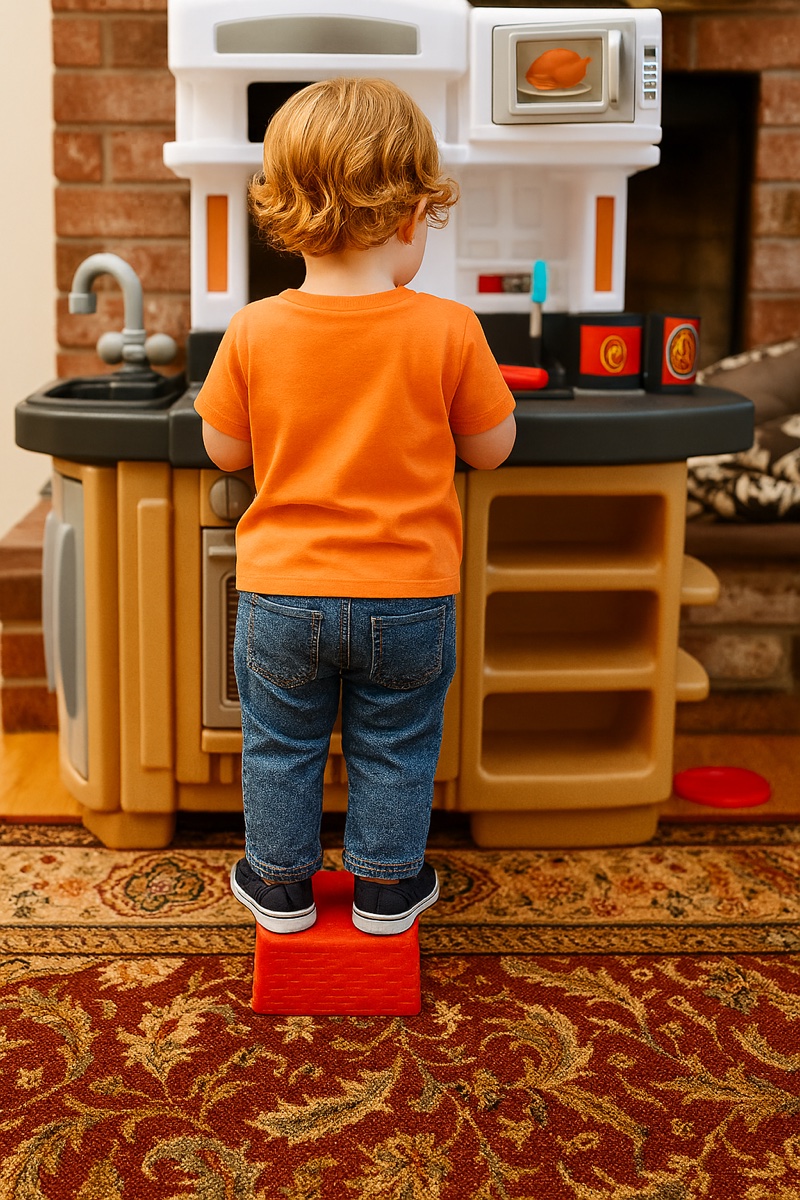
The second moment came at Christmas, when she was 20 months old. We had given her a little toy kitchen set with shelves, knobs, and small baskets tucked into the lower cubbies. She was too short to reach the top counter, and I expected her to ask for help.
Not Emrie.
I looked over and watched her solve the problem. She pulled out one of the small baskets, flipped it over, stood on it like a step stool, and reached what she wanted. No instruction. She recognized the problem, noticed an available object, and tried a solution on her own.
An illustration inspired by Emrie’s toy-kitchen solution at 20 months.
That spontaneous problem-solving stayed with me. It did not give me a Gf score. It gave me one more glimpse of how she approached something new.
10
⚡The Strength Side
When Fluid Reasoning Is a Strength
A child with strong Fluid Reasoning may enjoy discovering patterns, testing possibilities, solving unfamiliar problems, or inventing another route when the first one fails.
At home, you might notice:
Asks why a rule exists or notices when explanations are inconsistent.
Invents new uses for familiar objects or changes a game to make it more interesting.
Enjoys puzzles, building, strategy, experiments, or open-ended challenges.
Offers more than one solution to a practical problem.
Applies an idea learned in one situation to a different situation.
At school, you might notice:
Recognizes relationships or patterns in unfamiliar material.
Enjoys tasks that require reasoning rather than repetition alone.
Explains an unusual but logical route to an answer.
Needs meaningful challenge rather than simply a larger amount of the same work.
Boredom, conflict, bossiness, perfectionism, anxiety, and intense emotional reactions are not signs of high Gf by themselves, and strong Fluid Reasoning does not cause them. If those concerns are present, they deserve their own careful understanding and support.
Supporting a Fluid Reasoning Strength
At home:
Explain the reason behind rules and decisions when appropriate.
Offer complex, multi-step projects that require new thinking.
Allow room for more than one reasonable solution.
Teach patience, listening, and respect for different approaches.
Provide appropriate challenge so the child can practice persistence when an answer is not immediate.
At school:
Consider enrichment or acceleration when the student's data and school team support it.
Provide intellectual challenge, not merely more repetitive work.
Invite the student to explain the reasoning behind an answer.
Teach that mistakes and revised strategies are part of difficult problem-solving.
"A child who can out-think the rules still needs you. Not to keep up with their brain, but to hold their heart while it races." Rhonda Brimmer Austin, M.Ed.
11
🌧️The Leaky Barrel
When Fluid Reasoning Is Leaky
When this barrel holds less volume, unfamiliar or open-ended problems may feel like being dropped into a maze without a map. This does not mean your child is not smart. It means new reasoning tasks may require more structure, modeling, time, or guided practice.
What it might look like at home:
You might notice difficulty beginning something unfamiliar or uncertain. A new board game, a building toy without instructions, or a thank-you card without an example may require more support. The child may become frustrated when asked, "Can you just think of something?" or "Just pick something to wear." Watch for the pattern while remembering that several factors may be involved.
You might hear:
"I don't know how."
"Can you do it for me?"
"What if I mess it up?"
"Just tell me what to write."
A child can be very bright and still fear doing something the wrong way. The child may be looking for a clear starting point, and stress can make flexible thinking harder to access.
Some children may resist a new recipe, planning a family trip, or changing a familiar routine. That response may involve reasoning, anxiety, attention, language, sensory needs, executive functioning, previous experience, or several factors together. Observe the pattern before deciding what it means.
What it might look like at school:
In the classroom, difficulty with unfamiliar reasoning may become noticeable when a student cannot see how to begin an open-ended task. Assignments such as "Write a story," "Design your own experiment," or "Solve it your way" may require a model, a starting question, or a chance to talk through possibilities.
They may constantly ask:
"Is this right?"
"Can you check it?"
"What do I do first?"
Some students wait and watch others to learn what is expected before they commit to a response. That strategy may be useful information, but it does not establish a Gf weakness by itself.
They may also:
Copy other students' work or mimic examples to stay safe
Avoid challenges and stick with what they already know
Give up quickly when something doesn't work the first time
Hyper-focus on following instructions word-for-word without understanding the bigger picture
Their brain is not weak. The student may need structure while learning how to approach novelty and uncertainty.
The Emotional Impact
Repeated difficulty with unfamiliar problems can affect confidence. Some children begin to worry about what comes next, avoid taking a risk, or depend heavily on examples and adult reassurance. Anxiety, perfectionism, rigid routines, and distress during transitions are not caused by Gf alone and should not be used to infer a cognitive score.
Support the child's emotional safety while also teaching a repeatable problem-solving process: identify the goal, name what is known, choose one possible step, try it, and decide what to change.
12
🪜Ramps for Gf
How to Help at Home
These are possible ramps for unfamiliar or open-ended tasks. Choose supports that match the child's data, age, setting, and response:
Break multi-step tasks into visual steps or checklists
Model your own problem-solving out loud
Give them a "starter sentence" when they freeze
Offer structured choices instead of open-ended questions
Use family routines and calendars to give a sense of predictability
Let them preview changes ahead of time when possible
Praise their thinking process, not just their success
Example: Instead of "Good job solving that," try "I noticed you tried one way, and then changed it when it didn't work. That's flexible thinking."
What Might Help at School
Teachers can provide visual scaffolds or anchor charts during open-ended tasks
Step-by-step graphic organizers (especially for writing or problem-solving) help them sequence their thinking
Let them brainstorm with a peer or adult before starting
Use sentence starters or templates to reduce mental load
Allow "thinking time" before calling on them in class
Give advance notice for major transitions or changes in routine
Let them verbalize their plan before starting a multi-step task
Advocacy Language You Can Use
When talking to your child's school team, you might say:
"My child struggles when there's no clear starting point. They do better when they can preview a task or talk through the steps before jumping in."
"They need more structured thinking supports, not just academic support. It's not that they can't do the work. It's figuring out how to begin that overwhelms them."
Technology Tools That Help
Some children benefit from technology that provides a visible starting point or breaks a task into steps:
Task lists, visual timers, calendars, and reminder tools
Mind maps, digital boards, and voice memos for organizing ideas
Text-to-speech or writing supports when they are appropriate for the skill being taught or assessed
A Notes app for drafting a message or planning what to say
AI may help with brainstorming or restating directions when an adult supervises its use. Check age requirements, privacy terms, school rules, and data-retention practices. Never enter a child's name, unredacted evaluation, student record, or other identifying information.
13
🪞Adult Insight
This Isn't Just About Kids
If your child's struggles sound familiar, it might be because you've lived them, too.
Maybe you freeze when a project doesn't have clear steps.
Maybe you overthink emails.
Maybe you avoid starting things unless you know exactly how it'll go.
Those patterns can have several causes. If the Buckets and Barrels™ picture helps you recognize a similar need for structure in yourself, use that insight with curiosity rather than as a self-diagnosis.
Understanding your child's experience may help you recognize strategies that support both of you.
Modeling this work out loud ("Here's how I talk myself through when I don't know what to do next") might be one of the most powerful things you can do.
"Once I stopped pushing for the 'right answer' and started showing them how to think it through, I saw a different kid. They weren't lazy. They just didn't know where to start." Rhonda Brimmer Austin, M.Ed.
14
🔁The Big Picture, Again
When the Barrels Trade Places
One last look at the big picture, because this is where the two halves of this guide meet.
A child with a strong library and less-developed figure-it-out system may rely on familiar facts, examples, and routines when a task becomes new and open-ended. A child with strong novel reasoning and a less-developed library may solve an unfamiliar problem while needing more support with vocabulary or background knowledge. These are possible patterns, not fixed types.
That is why the barrels share a guide. Notice how the abilities may support one another, but remember that no single score, story, or behavior explains the whole child. Evaluation results, confidence intervals, history, instruction, observation, and classroom performance all belong in the conversation.
A Final Word
Your child is not lazy. Not broken. Just wired, with two barrels at fill levels nobody picked, trading and borrowing and doing their best under loads nobody sees.
If you haven't yet, complete The Fill Finder Questionnaire. It is a structured observation tool, not a standardized or norm-referenced assessment. The Bucket and Barrel Individual Profile summarizes the patterns you report and can help you decide which questions or Clarity Guides to explore next.
This guide describes cognitive patterns in plain language for educational purposes. Buckets and Barrels™ is Rhonda Brimmer Austin's original explanatory theory and educational tool. It does not diagnose a condition, estimate a cognitive-test score, replace a comprehensive evaluation, or determine special-education eligibility.
Still have concerns? A parent may request a full and individual evaluation from the local public school district. A written request documents the date and may trigger state-specific response requirements. Under federal IDEA rules, the evaluation timeline generally runs from the district's receipt of parental consent, or under a state-established timeline. In Texas, a properly directed written request generally requires a district response within 15 school days, and the evaluation report is generally due within 45 school days after written parental consent, subject to the state's rules and exceptions. Families should check their own state and local procedures.
"Every child has a different way of learning. When we understand their barrels, we stop asking, ‘What’s wrong with this child?’ and start asking, ‘How can we help this barrel hold what matters?’" Rhonda Brimmer Austin, M.Ed.